Mold Removal Miami: Check the Rules Before You Hire
A Miami homeowner calls about a dark patch spreading behind a bathroom wall, and the first company to answer offers a single quote: we will test the mold, then we will remove it. It sounds efficient. In Florida it can conflict with state law.
Mold Removal Services in Miami, FL
Honest pricing — final quote before any work starts
Mold Removal
Mold remediation in Miami explained for condo owners, with Florida's licensing, condo insurance and claim notice rules c…
Water Restoration
Water restoration in Miami from first extraction to the point where hidden mold, an independent assessor or a rebuild pe…
Water Extraction
Water extraction for Miami homes after saltwater surge or tidal flooding, with the insurance and drying questions answer…
Water Removal
Water removal for Miami condo units hit by a leak from the unit above, with the documentation and insurance steps explai…
Water Leak Detection
Water leak detection for older Miami homes, finding and documenting hidden leaks so owners can act on the repair and the…
Storm Damage Restoration
Storm damage restoration for Miami homes where storm water shows up inside walls months later, with the notice windows a…
Why Choose Us
The EPA's guidance on mold and moisture says water-damaged areas and items should be dried within 24 to 48 hours to prevent mold growth. After that window, a wet wall cavity in a Miami home is no longer only a drying job. It may become a mold job, with a different scope and, above 10 square feet, a different set of Florida rules.
-
01
FEMA Flood Zone AE at Miami City Hall
FEMA flood zone AE is one of the zones inside the Special Flood Hazard Area, the land FEMA maps as inundated by the 1-percent-annual-chance flood. Miami City Hall at 3500 Pan American Drive falls in zone AE on the county-hosted FEMA layer, at roughly 5.9 feet of ground elevation. That matters to an owner because a standard homeowners policy does not cover flood, so water that arrives as flooding is usually a separate policy question from a burst pipe.
-
02
Housing Built Before 1980 in Miami
Housing built before 1980 makes up 50.8 percent of the City of Miami's housing units in the ACS 2024 5-year estimates, and the median year built is 1979. An older home is not automatically a problem, but it often carries original plumbing runs, older window frames and layers of past patching that can hide a slow leak. For an owner, that means a stain may have a long history behind it, and the wet area inside the wall can be larger than the mark on the surface. The decision this supports is how far to look before anyone quotes removal: in an older home, find the source of the water first.
-
03
WASD Water Service and Your Meter
WASD, the Miami-Dade Water and Sewer Department, supplies potable water and sanitary sewer service to the City of Miami. The city's own water supply work plan says residents receive their potable water directly from WASD. That matters because a hidden leak shows up on the water account before it shows up on a wall, and an unexplained jump in usage is often the first sign. The decision it supports is whether to call for leak detection before any mold work begins, since removing mold without stopping the water only resets the clock.
-
04
The DBPR Licence Search
The DBPR licence search is the State of Florida's public lookup for licensed professionals, run by the Department of Business and Professional Regulation on MyFloridaLicense. Mold assessors and mold remediators are licensed under Chapter 468, Part XVI, and the statute restricts who may use the title mold assessor. For an owner, the search is the only check on a contractor that does not depend on the contractor's own website or sales call.
Why Choose a Company That Shows You the Florida Rules
Most mold pages in Miami tell you the company is the right one and stop there. We would rather show you the rules first, because once you know them, you can judge any contractor, including us. Florida regulates mold work under Chapter 468, Part XVI of the state statutes, and most of what an owner needs is in two short sections.
Section 468.8411 defines mold assessment and mold remediation as work on mold growth of greater than 10 square feet. Section 468.8419 says a mold assessor may not remediate a structure that the assessor or the assessor's company assessed within the last 12 months, and a remediator may not assess a structure it remediated within 12 months. Those two lines alone answer most of the questions owners bring to us.
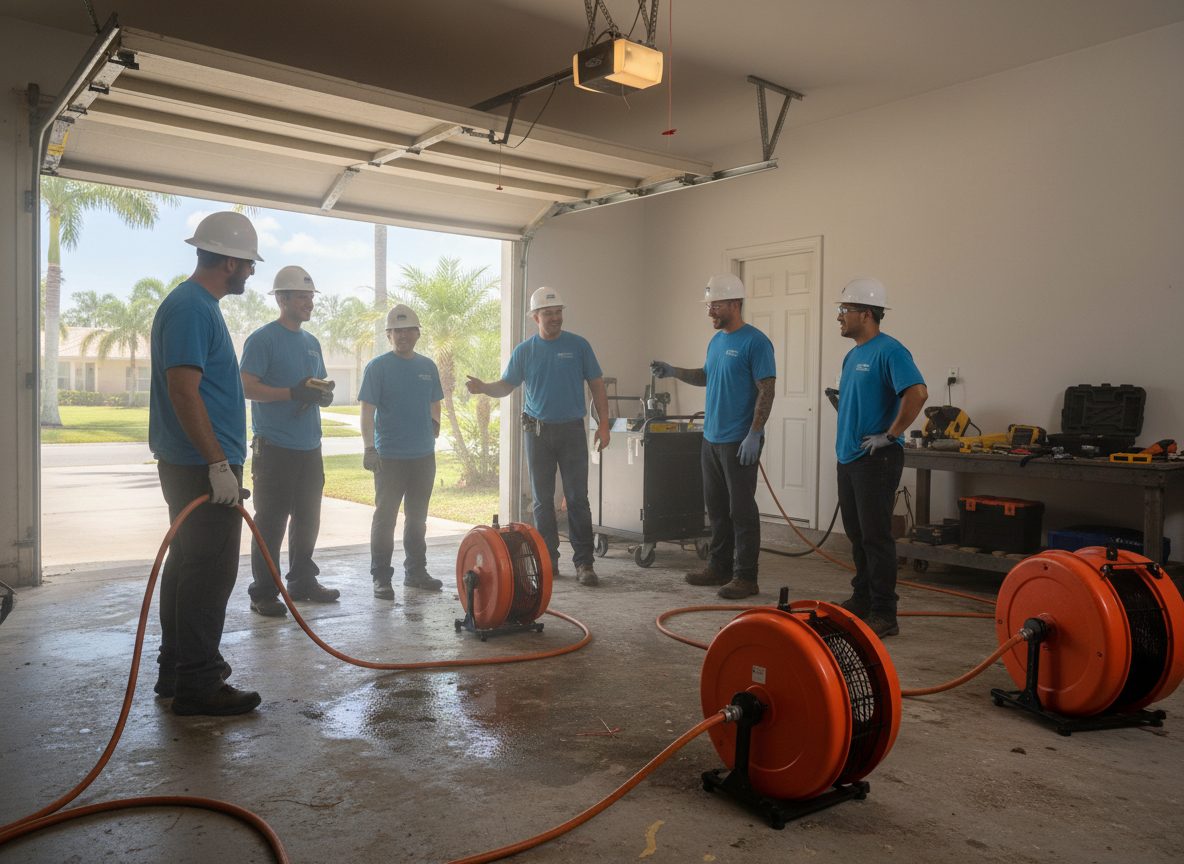
What to expect, start to finish
Inspection
We find where the water came from and stop it at the source where that is possible, then walk every room it reached and photograph what we see before anything is moved.
Moisture mapping
We take moisture meter readings across floors, walls and cabinets and record them on a simple map, so the wet area is measured rather than guessed and the readings can go to your insurer.
Extraction
Standing water is pumped and vacuumed out first, because the EPA advises drying water-damaged materials within 24 to 48 hours to prevent mold growth.
Drying
Air movers and dehumidifiers run until the readings return to the dry standard for each material. We re-read the same points each visit and log the numbers.
Remediation
Where mold is present, the affected area is contained and the growth and damaged material are removed and cleaned. Under Florida law, mold remediation of more than 10 square feet is regulated work under Chapter 468, Part XVI.
Verification
Final moisture readings are taken at the original points and handed to you in writing. For larger mold jobs you can hire an independent licensed mold assessor to check the result.
6
Specialist services
11+
Areas covered
Free
Estimates & advice
Service area
Mold Removal Near Me — Serving Miami, FL
Good to know
Mold Removal FAQs — Miami, FL
Still have questions? We're happy to talk it through.
+17869470281